
Choosing yourself—easy? Not really.
I take into account the people around me. When I choose myself, I’m afraid of disappointing them.
When I was younger, I acted quickly for my own well-being. I had nothing to lose and everything to gain.
So why is it harder today? As I get older, I know that my life choices will have a more immediate impact—I’ll have less time to recover or start over.
For example, if I want to change jobs, I have to consider that retirement is much closer now that I’m in my fifties. I need to carefully weigh the pros and cons and choose what will benefit me most. Money is easy to calculate—our well-being is not. Yet it should be a priority.
Choosing yourself is also difficult because it often means leaving a certain level of comfort—even when that comfort has become uncomfortable. I’ve gotten used to living with a situation I don’t like, but at least it’s familiar. Change feels difficult—it’s unknown, and I’ll have to learn how to navigate it.
While looking for tools to help me make a thoughtful decision, I thought again about the five basic needs identified by Abraham Maslow, which I studied in a business course. These needs are represented in the form of a pyramid.
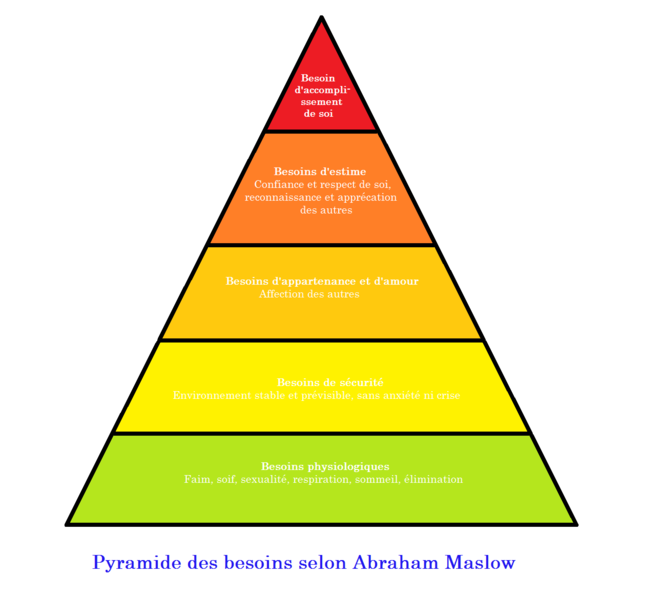
Starting from the bottom of the pyramid, I’ve fulfilled the first four needs over the course of my life. All that remains is to reach the top. It’s not that I don’t feel accomplished—but this is an area I still want to fully develop.
It’s not necessary to fulfill these needs in a strict order. What matters is trying to meet them all at some point in life. The hardest part isn’t always reaching them—but maintaining them. At certain times, we may lose one of these “needs” due to circumstances beyond our control (a separation or job loss). We may then need to rebuild, perhaps in a different way. And sometimes, we may need help to regain what was lost.
At times, we feel torn between the desire to make changes in order to fully grow—and the fear of losing something we’ve worked hard to achieve.
In the end, choosing yourself comes with its share of insecurities, moments of happiness, and many questions.
I continue to reflect—because as René Descartes said, “I think, therefore I am.”